
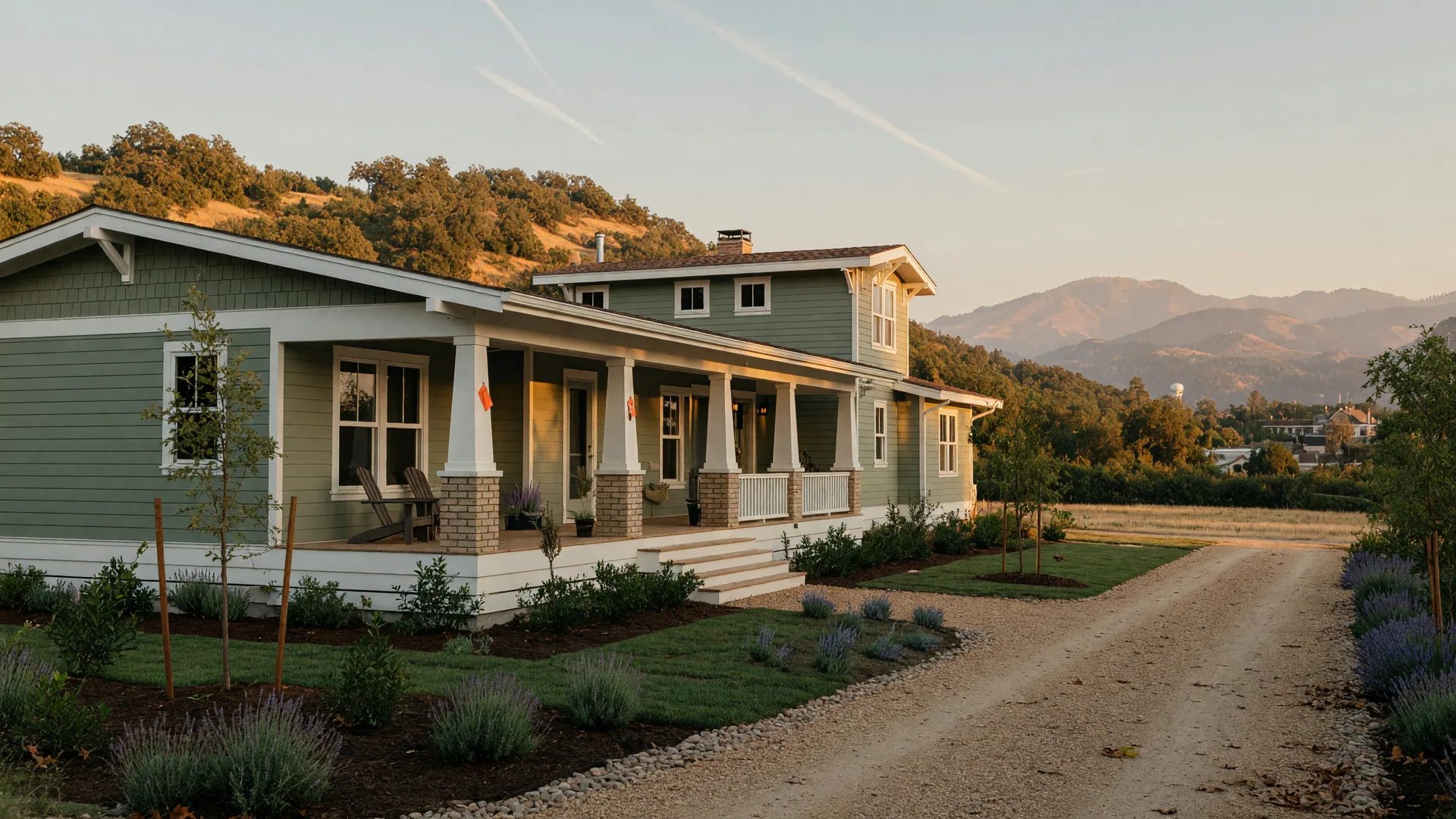
Jacksonville is one of the most special places in the Rogue Valley, and it is also one of the trickiest places to build something new. The town became a National Historic Landmark District back in 1966, and that designation shapes nearly everything about how new construction happens here. If you are dreaming of a brand-new home with the character of an old one, set among oak-covered hillsides and vineyards and just a short drive from Medford, this guide walks you through how Jacksonville's new construction actually works: the permitting, the design review, the neighborhoods, and what it all costs.
A new home in a town that is already complete
Driving through Jacksonville, it is easy to see why people fall for it. The historic downtown is walkable and full of character. The streets are lined with mature trees. The whole town feels finished, settled, and loved. That is the charm, and it is also the reason new construction here looks different from the big production neighborhoods going up elsewhere in Jackson County.
Most new building in and around Jacksonville is infill or custom work on a rare lot, not acre after acre of identical floor plans. Because the historic district is protected, a new home has to earn its place. The payoff is a finished product that feels like it belongs, often for buyers who want mountain views, vineyard parcels, or a touch of gold rush history that you simply cannot get on a typical subdivision lot.
You do not build on a whim here
The first thing to understand is that Jacksonville runs its own building permit program. Unlike many towns where the county handles the process, the City of Jacksonville issues its own construction permits inside city limits. Jackson County handles only the electrical permits for the city. That means the permitting experience here is a local one, and the people you work with know this town intimately.
If you are building within the historic district, which covers much of the residential core, you need a Certificate of Appropriateness from the Historic and Architectural Review Commission, or HARC, before a building permit can be issued. The review assigns a level, generally one of three tiers, depending on whether your property contributes to the historic character, sits as a non-contributing structure, or affects a sensitive view. The stricter the level, the more detailed the review.
Budgets matter here too, and it is worth knowing the full picture. Alongside plan review fees there is a Community Development Fee, which the city sets at 1.95 percent of the construction value, plus a state surcharge, a technology fee, and System Development Charges that go toward infrastructure in the community. A custom build in Jacksonville is genuinely a custom process, and a good team will price that in from the start.
Design guidelines that reward restraint
This is the part of building in Jacksonville that surprises the most buyers, and it is worth understanding before you fall in love with a lot. HARC evaluates projects through public hearings against the criteria in the Jacksonville Unified Development Code, particularly the historic protection rules. The commission applies the city's Residential Design Guidelines, which themselves reference the Secretary of the Interior's Standards for Rehabilitation.
What does that actually mean for your home? For new residential construction, the home must be scaled and sized to fit the character of the surrounding houses and buildings. A new house in Jacksonville should not tower over its historic neighbors. You can expect to present architectural details like roof type and pitch, wall siding, windows, doors, and trim, plus elevations and material samples. The idea is that a new home reads as a good neighbor to a town that predates Oregon statehood as much as it does a fresh start.
What this means in practice: choose a builder and architect who have experience with historic settings and design review, and build extra time into your timeline. A thoughtful design that satisfies the commission is absolutely achievable, but it is not the same as picking from a standard builder lineup. Plan for it, and the result is a home with real curb appeal that you cannot buy off a lot plan sheet.
Infill lots, hillside views, and custom builds
New construction in Jacksonville tends to show up in a few distinct places. In-town infill is one of them. Recently, for example, a brand-new construction home built by H3 Homes came to market at 205 North Oregon Street, a rare chance at a truly new house inside the historic town. Listings like this do not sit long, because the supply of new builds here is genuinely small.
Then there are the hillside neighborhoods. Andrews Place is an exclusive hillside subdivision made up of roughly eight buildable homesites, the kind of place where the views and the privacy do most of the selling. Stage Coach Hills is another luxury custom-home neighborhood in the area, catering to buyers who want a modern home in a scenic, established setting.
Just outside town, the countryside stretches toward the Applegate Valley, where much of the building is custom work on ranch and vineyard parcels. Builders like Applegate Rogue Building Company and Riverdell Construction do custom homes across Jacksonville, Ashland, and the Applegate area, suited to buyers who want provenance and a one-of-a-kind layout over a standard subdivision home.
If your heart is set on this part of the valley but you would like more production inventory to choose from, nearby Medford and Eagle Point offer that in greater volume. I have written separately about the communities and builders in those markets, and they share the same gorgeous mountain light and quick access to Jacksonville's downtown. The tradeoff here is really about character versus choice.
A premium worth planning for
Jacksonville is consistently one of the most expensive corners of the Rogue Valley, and that is no accident. Through early 2026, Jackson County's median home sale price ran in the mid-$400,000s, with Redfin recording roughly $466,000 in March. Jacksonville sits clearly above that. By June, Redfin put Jacksonville's median sale price near $542,000, and an early-year snapshot of the county's cities ranked Jacksonville in the same top tier as Ashland, above most of the rest of the valley.
For new construction specifically, you are paying for the lot, the build, and the constraints of building well in a protected place. That tends to mean a higher entry point than a comparable square footage in a Medford subdivision. But buyers who land here are typically buying more than a house. They are buying proximity to a historic downtown, the Britt Music Festival, the surrounding wineries, and a lifestyle that a lot of people want and very little inventory supports.
If this sounds like you, Jacksonville might be the fit
Building in Jacksonville is not for everyone, and that is okay. It suits buyers who prize character and context, who want to walk out the door into a historic downtown, who can picture themselves enjoying a summer Britt concert or an afternoon tasting at a nearby winery, and who value a small-town community. It also suits relocating and second-home buyers coming from higher-priced metros who find the quality of life here a meaningful step up without leaving urban amenities behind.
If you need a large production neighborhood with quick move-in availability, or if your budget is tighter, the surrounding communities in Medford, Eagle Point, and Central Point will serve you better, and I can point you to the right builders there. Jacksonville is best approached by the buyer who is willing to trade a little convenience for a lot of charm.
Practical steps before you commit to a lot
I have walked buyers through this exact process, and a little preparation saves a lot of heartache. Here is where I would start:
- Talk to the city planner early. Before you commit to a lot, understand what design review will require on that specific parcel and which of the three review levels is likely to apply.
- Choose an experienced team. A builder and architect who have navigated Title 18 reviews and the Historic and Architectural Review Commission will save you time, money, and design revisions.
- Budget for design help. Architectural elevations, material samples, and good detailing matter under review, so plan for them rather than treating them as an afterthought.
- Build time into the timeline. Between design review, public hearings, and permitting, expect a longer runway than a typical subdivision build. Treat it as part of the experience.
- Know the full fee picture. Plan review fees, the Community Development Fee at 1.95 percent of construction value, the state surcharge, technology fees, and System Development Charges all add up. Get a complete estimate early.
- Compare across the valley. If you love Jacksonville but want more inventory or a lower entry point, let me show you what is available nearby in Eagle Point, Central Point, and Medford with similar views.
Let's map out your options
Whether you want a custom build in the historic town, a hillside homesite, or the closest new construction nearby, I can help you weigh the tradeoffs and find the right fit for your budget and lifestyle. I know the lots, the builders, and the review process, and I would love to put that knowledge to work for you.

Lisa Sears, REALTOR®, eXp Luxury
Serving Southern Oregon