
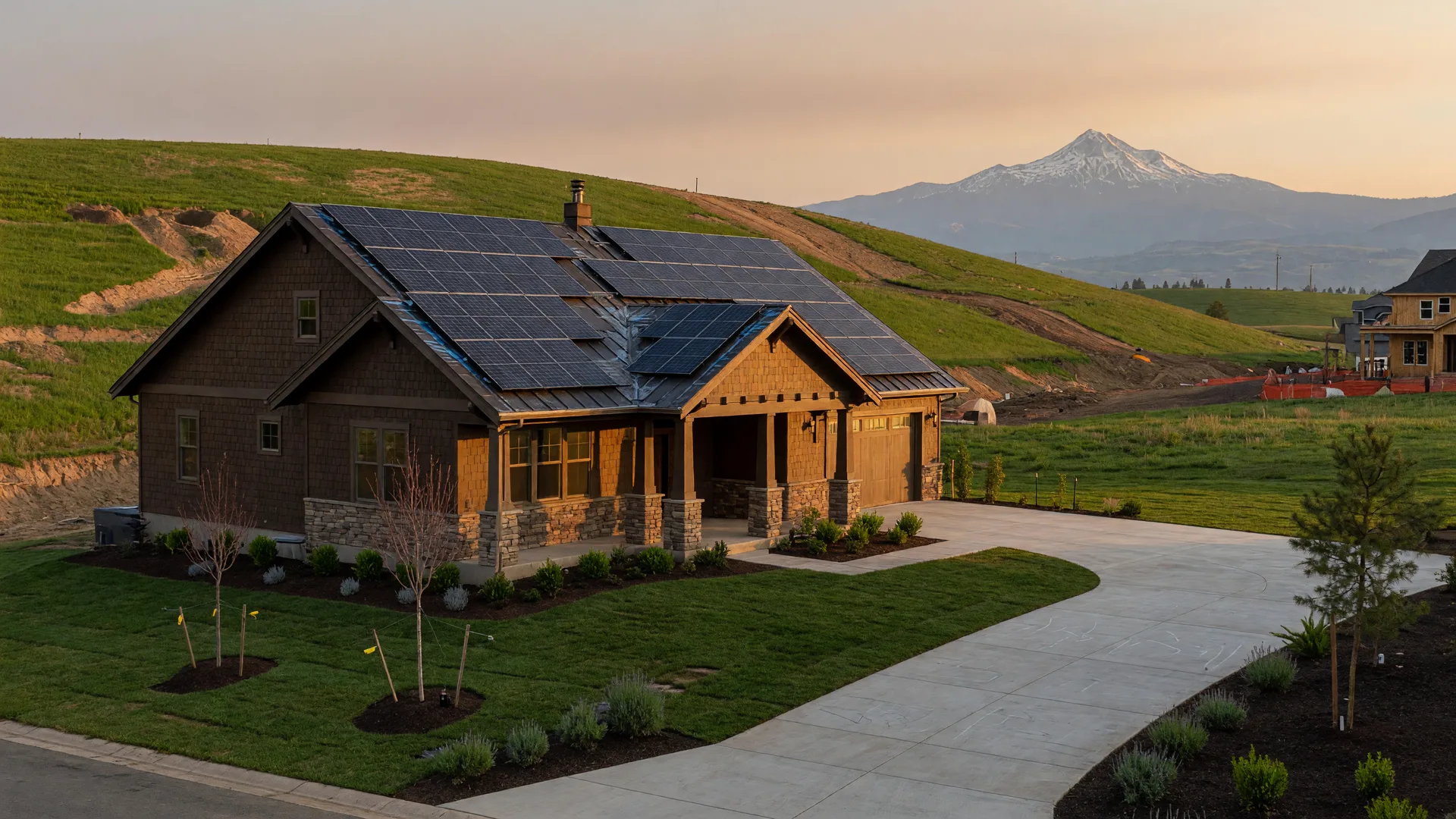
Solar panels used to feel like an optional extra on a new home, something you would budget for later. That is changing fast. Oregon's 2026 residential building code now requires every new home to include an on-site renewable energy system, which for most builders means solar panels or an equivalent. If you are shopping for new construction in Medford, Grants Pass, Eagle Point, or anywhere else in the Rogue Valley, this new rule directly affects what your home includes, what it costs, and how it performs.
The good news? Southern Oregon is one of the best places in the state to generate solar power, with bright, sunny summers and a mild climate that makes rooftop panels genuinely productive. As a buyer, this requirement is mostly good news, but it does raise real questions worth answering before you sign. Here is what the change is, what it means for you, and what I tell every buyer who asks about it.
What Oregon's 2026 code now requires
Oregon adopted the 2026 Oregon Residential Specialty Code, the state's updated residential energy rules, with the residential board approving the new package in February 2026. The headline change is a brand new requirement: new single-family homes must include an on-site renewable energy system, described in the summary as "solar or equivalent." The required system size is roughly 4 kilowatts of capacity, or about 1.5 watts per square foot of living space, depending on how the code change is applied to a given plan.
This is a meaningful shift. Previously, a new home simply had to be "solar ready," meaning the roof and wiring were positioned so panels could be added later. Under the 2026 rule, the renewable energy system has to actually be there from day one, not just be something you can add down the road.
It does not travel alone. The 2026 package also builds on the wider energy standards already reshaping new builds here: heat pumps in place of conventional air conditioning, balanced ventilation with heat or energy recovery, tighter air-leakage limits, and higher insulation values. Taken together, estimates suggest a new Oregon home built to the 2026 code will be roughly 27 percent more efficient than one built under the previous code. If you want the full picture on the heat pump piece specifically, I wrote a separate guide to that change.
Southern Oregon is built for solar
If you are worried that solar panels make less sense in the Pacific Northwest, let me put that to rest. Medford is among the sunniest cities in Oregon, with roughly 195 sunny days a year and about five peak sun hours per day on average. That is well ahead of Portland, and it makes the Rogue Valley one of the highest-producing solar regions in the state. Your panels here genuinely work, and they work hard.
We already see this working in new construction across the valley. Several Ashland communities, including Beach Creek by KDA Homes and West Village by Taylored Elements, have been building solar panels and Earth Advantage certified, net zero ready homes for a while now. What was once an Ashland specialty is on its way to becoming the standard for new homes throughout Southern Oregon. I walk through the Ashland solar-built communities in more detail in my Ashland new construction guide.
What solar will cost you, and what helps offset it
The most common question I hear is whether this drives the price of a new home up. It can, because solar equipment is part of the build. But it is worth understanding that the system is folded into the overall cost of the house, which means it is most likely financed as part of your mortgage rather than paid as a separate lump sum out of pocket. The practical question is what your particular builder is offering, and I always tell buyers to ask directly: what size system is included, what equipment, how it performs, and what warranty covers it.
Several programs can help reduce the effective cost, though you should treat their current status with some care since incentives shift:
- The federal 30 percent residential solar tax credit expired at the end of 2025, so do not assume it applies to a 2026 purchase. Always confirm the current federal picture with your tax professional before counting on a credit.
- The Oregon Solar + Storage Rebate Program offers up to $5,000 for solar and $2,500 for battery storage, but as of mid-2026 its funding was fully reserved and it was not accepting new reservations. Check the Oregon Department of Energy for the latest status.
- Energy Trust of Oregon offers solar incentives for utility customers, typically in the range of $2,500 to $3,500 depending on your utility, with higher amounts for income-qualified households. Pacific Power serves much of the Rogue Valley, so that is who most of us deal with.
- Oregon exempts the added value of home solar equipment from property taxes, so the panels generally will not push your yearly tax bill up the way other additions might.
- Net metering is available through Pacific Power and PGE. When your panels produce more than you use, the excess credits to your account, which keeps daytime summer production from being wasted.
Questions to ask every builder about the solar package
Because solar is now baked into the build, the details matter more than ever. Here is the short list I run through with every new construction buyer in this situation:
What is actually included? Ask for the system's size in kilowatts, the number of panels, and whether it is owned outright with the home or structured through a lease or power purchase agreement. An owned system stays with the home and is part of your purchase.
How much will it actually produce? Your builder or the installer should be able to share an expected annual output for your specific roof and orientation. Shading, roof angle, and tree cover all change the real number, so get something specific to the lot.
What warranty covers it? Panels and inverters carry their own warranties separate from the home's structural warranty. Ask for the terms in writing so you know exactly what is covered and for how long.
Does the HOA allow panels, and where? Even with the state requirement, a community's design rules can influence panel placement and equipment. Ask the HOA directly so there are no surprises about visibility or placement on your roof.
How does this affect my monthly costs? Between the mortgage impact of the system and the likely reduction in your electric bill, ask the builder to walk you through the full picture. In a sunny market like ours, well-sized systems often more than pay for themselves over the life of the home.
What this means for the value of your home
Longer term, this requirement is good for resale value. An energy-efficient home with a working solar system and lower utility bills appeals to a wide range of future buyers, especially in a region where electricity demand rises with our hot summers. A home that already includes these systems is simpler to sell and value than one where a buyer would have to add them later.
The shift also reflects where the broader market is headed, which I have been tracking closely in the posts I write for buyers. If you want the full context on the energy-focused changes, my guides on Oregon's updated energy codes and the heat pump requirement break those down in detail. Together they give you a complete picture of what a modern new build in Southern Oregon includes.
My honest take as someone who has walked buyers through new construction across this valley for decades: solar coming standard is a win. The panels are productive here, the energy savings are real, and builders are figuring out how to deliver them cleanly and affordably. Your job as a buyer is simply to ask the right questions so you know exactly what you are getting, and to compare how different builders handle the requirement.
Let me walk you through the builders and their solar packages
I have toured the new construction communities across Medford, Grants Pass, Eagle Point, and Ashland, and I know how each builder is handling the new renewable energy requirement. Whether you want to understand a specific builder's solar package or just compare communities side by side, reach out. I will help you sort through the details, ask the right questions, and find the right fit.

Lisa Sears, REALTOR, eXp Luxury
Serving Southern Oregon