
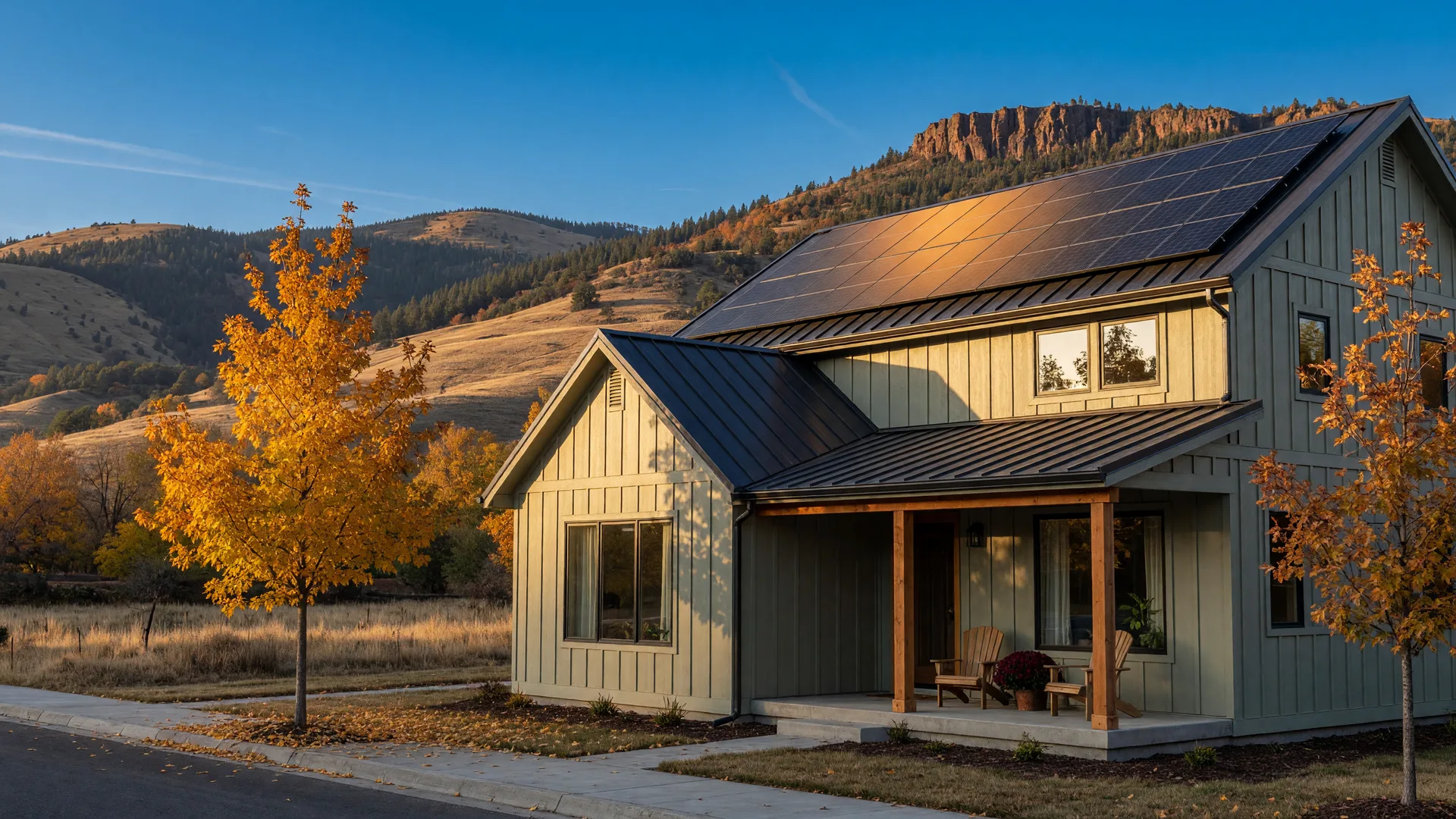
One of the smartest things you can do when comparing new construction homes in Southern Oregon is ask about the Energy Performance Score, better known as an EPS. It is the whole-home energy rating system that Energy Trust of Oregon uses for new homes, and it gives you something most buyers never get anywhere else: an estimate of what the home you are considering will actually cost to run, before you sign anything. The score is verified by a third-party inspector and printed on a standard score sheet, so it is a real number, not a sales pitch. Here is how EPS works, what the score sheet tells you, and the questions to ask your builder in Medford, Grants Pass, Eagle Point, or Jacksonville.
I have walked buyers through new construction across the Rogue Valley for years, and energy questions come up on almost every tour. This post lays out the basics of the program, what changed in 2026, and how you can use an EPS to compare two new homes on an even footing.
What is the Energy Performance Score?
The EPS is Oregon's whole-home energy rating for new construction, developed and run by Energy Trust of Oregon, a nonprofit that helps Oregon utility customers save energy. Energy Trust has offered the program to builders since 2009, and in that time it has become the standard way Oregon documents how efficient a newly built home really is. Builders sign on as Energy Trust trade allies and agree to build the home above the efficiency of a typical newly built Oregon home. A third-party verifier then scores the finished plans and the completed home, and every qualifying home gets an official one-page EPS score sheet.
Eligibility matters for Southern Oregon buyers, and the news here is good: the program covers homes served by Pacific Power, Portland General Electric, NW Natural, Cascade Natural Gas, and Avista. Pacific Power is the main electric utility across most of the Rogue Valley, so the vast majority of new construction in Medford, Grants Pass, Eagle Point, and Jacksonville falls inside the program's service area.
What an EPS score sheet actually tells you
The EPS score sheet is built for a buyer, not an engineer. On that single page you get four things:
- An energy score on a zero-to-200-plus scale, where lower is better. The average existing Oregon home scores around 126, so a new home in the 50s or 60s is a dramatically more efficient house.
- Estimated average monthly and annual energy costs, broken down by fuel. You see the electric side and the gas side separately, which is useful because heated space and water heating often use different fuels.
- An estimated carbon footprint in tons of CO2 per year. The sheet adds context, for example that one ton is roughly equivalent to about 2,000 miles driven by a typical car.
- A comparison to similar-sized homes and a list of the home's efficiency features. You can see at a glance which features are doing the heavy lifting, from the heat pump system to the insulation package to the solar array.
The headline benefit is the estimated utility cost. In a resale home you can ask the seller for past power bills, but a brand new home has no history. The EPS score sheet fills that gap with a modeled utility cost for the exact plan and lot, so you are not guessing about the single biggest recurring expense of homeownership.
How EPS is different from a HERS rating
You may have heard of the HERS index, which is common in other states, so it helps to know how the two compare. HERS is a relative index on a 100-to-0 scale: a home scoring 100 is built to the reference code baseline, and lower numbers mean a more efficient home. It tells you how a home stacks up against that benchmark, but it does not tell you what the home will cost to run, because it does not directly reflect the size of the house or your actual consumption.
EPS is an absolute measure. It reports estimated energy consumption, estimated dollars, and estimated carbon, so you can compare two different-sized homes meaningfully, the way you would compare two cars by miles per gallon rather than by a sticker rank. In Oregon new construction, the score you are most likely to see in the paperwork is the EPS.
How the program works, from the buyer's seat
To qualify for an EPS, a builder designs the home to beat the efficiency of a typical newly built Oregon home. The minimum is 5 percent above the baseline, but in practice most participating homes are built at least 10 percent above it, and Energy Trust says the average rated home comes in about 20 percent above. A third-party verifier independently confirms the performance, which is what makes the score credible rather than marketing.
Buyers benefit in two ways. First, you get the verified score sheet and the estimated utility costs, which protect you from surprises after move-in. Second, Energy Trust pays the builder a cash incentive for each qualifying home, and that money helps offset the cost of the high-performance features, which is part of why efficient homes at this level often sell for a smaller premium than you might expect. The incentive goes to the builder as a trade ally; your gain is the upgraded home and the documented efficiency at a more competitive price.
The 2026 incentive picture for energy-efficient new homes
Energy Trust's whole-home builder incentives run from about $1,000 to $4,850 per home, scaling with how far the home performs above the typical baseline. This year the program got noticeably stronger. In May 2026, Energy Trust announced increased incentives for market-rate homes that are at least 10 percent above code, with additional incentive value for homes that keep ductwork inside the conditioned space, a detail that quietly makes a big difference in comfort and efficiency in Southern Oregon's climate.
On top of that, federal Climate Pollution Reduction Grant funding adds $750 more per home for homes that score at least 10 percent above code, and $1,550 per home for projects that meet affordable, rural, and Tribal criteria. Oregon has plenty of rural communities, and builders building in Grants Pass, Eagle Point, or the Applegate Valley can be exactly the kind of project those add-ons were written for.
Two honest caveats before you build a budget around these numbers. The incentives are published by Energy Trust and they update, typically taking effect on January 1 each year, and every incentive is subject to funding availability. And because the money flows to the builder, the practical question for you is not how much cash the builder receives, but whether the home is built to qualify in the first place, because that is what delivers the score sheet and the efficiency.
What EPS means for Southern Oregon buyers right now
Because Pacific Power serves most of the Rogue Valley, local buyers are unusually well positioned for this program. And local builders are already participating. Energy Trust notes that Mahar Homes of Medford, the largest custom homebuilder in the Rogue Valley, has shown multiple EPS-rated homes on the Southern Oregon Tour of Homes, and Energy Trust runs a dedicated Southern Oregon section on its "Step Inside an EPS Home" page featuring participating builders. These are homes you can walk through and tour locally, not just read about.
EPS also ties together the code changes I have been writing about this year. New homes in Oregon are now built with heat pumps, designed around Oregon's updated energy codes, and planned with solar or an on-site renewable equivalent under the new requirements. The EPS is the single score card that pulls all of those systems together and prices their combined impact, which makes it the most useful number on the table when you are standing in a model home. If you want the background on each piece, my guides to the heat pump requirement, the solar requirement, and Oregon's updated energy codes cover each one in depth.
Questions to ask your builder about an EPS
- "Will this home be EPS-rated?" If the answer is yes, ask to see a score sheet from a completed home of the same plan. A model home's score is great, but the one that matters is for the exact plan and lot you are buying.
- "What are the estimated monthly utility costs on the score sheet?" Compare that number to a similar-sized home on the same street. The score sheet breaks out electric and gas, so you can see exactly where the money goes.
- "Is the builder an Energy Trust trade ally?" That is simply how Energy Trust describes participating builders. If the answer is yes, the builder already knows the program, the verification, and the current incentive grid.
- "Which utility serves this lot?" Pacific Power covers most of the Rogue Valley, but the program also covers NW Natural and Avista customers, so confirm the territory for the specific home you are considering.
- "What incentives are current right now?" Energy Trust's incentive schedule updates, typically each January, so ask what applies today. And remember: lower scores are better, but only compare homes of similar size and layout.
The Energy Performance Score is the closest thing new construction has to an honest utility bill before you move in. If you are comparing homes across Medford, Grants Pass, Eagle Point, or Jacksonville, asking for the score sheet is a five-minute question that can save you thousands of dollars a year, and it tells you a lot about which builders put real thought into how their homes perform. Bring it to every tour, and look at the number the same way you look at the floor plan: as part of what makes a house worth its price.
Let me help you compare new homes by efficiency, not just price
I have toured new construction across the Rogue Valley and I know the builders who take energy performance seriously, from the EPS-rated custom homes in Medford to the code-plus production communities in Grants Pass and Eagle Point. If you are weighing two communities and want a straight answer on which one costs less to live in, I would love to walk the numbers with you. Reach out and let's make a plan.

Lisa Sears, REALTOR, eXp Luxury
Serving Southern Oregon