Financing a newly built Southern Oregon home is not the same transaction as buying a finished house, and the difference usually comes down to one question: is there already a roof on the property? If you are buying a production home in a completed or near-completed community, you use a standard mortgage that closes when you take the keys. If you are building on a lot, the lender is funding the construction itself, which is what a construction-to-permanent loan, sometimes called a one-time-close loan, is designed to do. Here is how the two paths work, what rates and down payments look like as of late 2026, and the practical questions to ask before you pick either one.
I have helped families buy new homes in Medford, Grants Pass, and Eagle Point for a long time now, and the financing is usually the piece that surprises them the most. Not the price or the timeline, but the fact that the loan itself is structured differently when the builder is still swinging a hammer. Let me walk you through it the way I do with new buyers.
When a regular mortgage is all you need
Most people buying new construction in the Rogue Valley are buying a home that a production builder like DR Horton, Hayden Homes, or Holt Homes has already built or is about to finish in an active community. If the home is complete, or if you are buying a spec home that will close at the end of the build, you finance it exactly like you would finance any house: you get pre-approved for a traditional purchase mortgage, and closing happens when the keys change hands. The builder may offer a preferred lender incentive, which usually means a reduced rate or closing-cost credit if you finance through their approved lender and in-house mortgage company.
The wrinkle in an active community is timing. If the sales office sells you a home that is still months away from completion, the builder does not want to hold the property off the market for you indefinitely. Your loan needs to be ready to fund at the completion date, and builders care a great deal about whether your pre-approval is solid and on time. That is one reason I encourage buyers to get their financing lined up early, before they fall in love with a lot, not after.
The two ways to finance a custom build
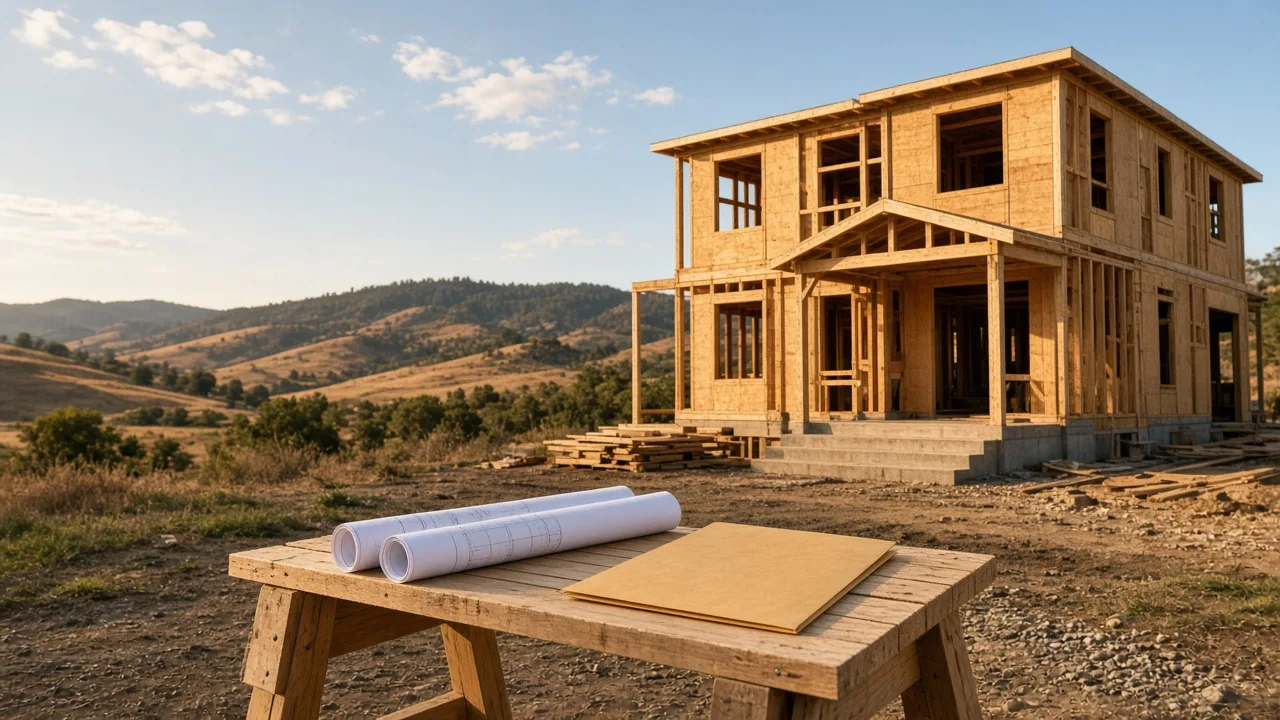
When you are building on a lot you own, or buying the lot and building in one move, a regular purchase mortgage does not fit, because there is no finished home for it to secure yet. Lenders use a construction loan, and that loan comes in two flavors.
This is the most common path for an owner-builder, and it wraps everything into a single loan. One application, one closing, one set of closing costs. During the build, money is released to your builder in stages as the work is completed, and you pay interest only on the amount actually drawn. When the home is finished and passes inspection, the loan automatically converts into your permanent 15- or 30-year mortgage. One-time-close loans also let you lock your rate and secure the land in the same transaction, which can protect you if rates climb while construction drags on.
The alternative is a separate construction-only loan to fund the build, followed by a second, entirely separate mortgage once the house is complete. You go through two closings and pay closing costs twice, and rates on a stand-alone construction loan tend to run higher. The advantage is flexibility: you shop your permanent mortgage separately at the end, when you can compare current rates rather than being tied to the lock you set at the start. Some buyers prefer this; most find the one-time-close simpler.
How construction draws work, and why inspections matter
With a construction-to-permanent loan, the lender does not hand the full balance over at closing. Instead, funds are released in draws tied to major stages of the build, usually the foundation, the framing, the mechanicals like plumbing and electrical, and the final finish-out. Before each draw, the lender sends someone to confirm the work is actually done, and your builder submits the paperwork to get paid. This is also your opportunity to walk the site with your own inspector, because it is far easier to fix a concern before the walls are covered than after.
One of the smartest moves I see is having a licensed third-party inspector review each phase alongside the lender's draw inspections. Oregon already requires staged building inspections through the permitting jurisdiction, so you are never starting from scratch. A private inspector adds an independent set of eyes for you, the buyer, separate from the county's or the city's compliance review. I go deep on this in my new home inspection guide, and in my custom building guide I cover the full timeline and lot costs that sit on top of the loan.

What rates and down payments look like right now
Lending rates move constantly, so treat any single number as a snapshot rather than a quote. As of November 2026, the national average for a 30-year fixed mortgage sat near 7.2%. Construction-to-permanent financing typically runs about one to two percentage points higher than a standard mortgage, because the lender is carrying the risk of an unfinished home, and several 2026 lender guides point to one-time-close rates in the 7.25% to 8.75% range. Stand-alone construction-only loans often sit another step higher, roughly 7.75% to 9.25%, which is part of why the one-time-close route tends to be the more budget-friendly of the two.
Down payments are the other thing to plan around. Conventional construction-to-permanent loans commonly ask for 20% to 25% down, though some lenders will underwrite at 10% to 15% with mortgage insurance. FHA programs are available with credit scores around 620 and a lower down payment, and VA and USDA buyers can often finance with nothing down. In the Rogue Valley I meet buyers building on acreage who expected to finance the lot too, so it is worth confirming with your lender whether your construction loan can wrap in the land purchase or whether you will bring the lot to the table paid for.
~7.2%
National average as of November 2026, the baseline most buyers compare against.
7.25-8.75%
Typical construction-to-permanent rate range cited across 2026 lender guides.
10-25%
Conventional builds commonly run 20-25%; some lenders take 10-15% with mortgage insurance.
The USDA single-close construction loan, and why it fits parts of our area
USDA Rural Development offers a single-close construction-to-permanent loan that can be a strong fit for buyers building in eligible rural parts of the Rogue Valley. It combines the interim construction loan with the permanent 30-year mortgage in one closing, allows up to 100% financing so there is no down payment, and extends to one-unit site-built homes on approved lots. Qualifying rules include a household income at or below 115% of the area median for the county, and the property must sit in a USDA-eligible area. The construction phase is typically limited to around twelve months, and you must work through a lender approved by USDA that has construction lending experience.
Rogue Valley buyers have used the USDA route for everything from starter homes outside city limits to more remote acreage parcels, and it pairs well with the county's stock of empty buildable lots. If you are a first-time buyer or building on a modest budget and the land qualifies, this is a genuinely useful door to walk through before you assume a large down payment is unavoidable.
What Oregon's homebuyer programs do, and do not, cover
Oregon Housing and Community Services (OHCS) runs the state's homebuyer programs, FirstHome for first-time buyers and NextStep for repeat buyers, both sold through approved Oregon lenders. They pair a below-market first mortgage with down payment assistance of 4% or 5% of the loan amount, and that assistance is forgivable for borrowers at or below 80% of area median income. They accept credit scores from about 620, cap household income around $125,000, and allow conventional loans up to 97% of the value. My down payment assistance guide lays all of this out in detail.
The key word there is purchase-money. FirstHome and NextStep are structured for buying a completed home, so if you are building on your own lot rather than buying a finished house, ask an OHCS-approved lender directly whether the program can be combined with a single-close construction loan. And note the distinction worth knowing: in 2026 OHCS also launched a Construction Loan Guarantee Program, but that one supports affordable-housing developers and lenders building rental and for-sale projects, not an individual buyer. For a personal build, the consumer programs are what matter.
Questions to ask your lender before you sign
- Is this a one-time-close or two-close construction loan? The answer changes how many times you close, how many sets of closing costs you pay, and your flexibility to shop the permanent rate later.
- Does the loan include the lot, or do you own the land free and clear? Building on acreage in the Rogue Valley often means bringing the parcel to the table, and you need to know which side of that you are on.
- Can I lock my rate, and for how long? With a longer custom timeline, a rate lock that runs through the build can be the difference between knowing your payment and gambling on it.
- Do I need an OHCS- or USDA-approved lender? If you plan to use state down payment assistance or a USDA single-close loan, the lender must be approved for that program, and not every bank is.
- Who is approved to build with this loan? Lenders underwrite the builder as much as you, and a custom builder with a strong track record and clean licensing makes the loan far easier to approve at a better rate.
The short way to think about new construction financing in Southern Oregon is this: buying a finished production home is a mortgage transaction, and building on your own lot is a construction transaction, and they behave differently. A construction-to-permanent loan simplifies the build with one closing and a rate lock, while USDA and OHCS programs can put a no-down or low-down path within reach. Whichever way you go, laying the financing groundwork before you choose your lot is the kind of step that turns a stressful process into a smooth one. My step-by-step buying guide walks the whole timeline, and my guide to the real cost of new construction shows how loan costs, lot premiums, and construction fees add up beyond the base price.
Let's match the financing to the right new home
Whether you are touring production communities in Medford or Grants Pass, or weighing a custom build on a lot in Eagle Point or Jacksonville, I am happy to help you connect the financing options with the right property. We can look at the communities you are considering and talk through which lending path fits before you commit.

Lisa Sears, REALTOR, eXp Luxury
Serving Southern Oregon